
Nitrite Detection at Trace Levels: Insights from a Lactose Case Study on Ion Chromatography and Sonication Effects
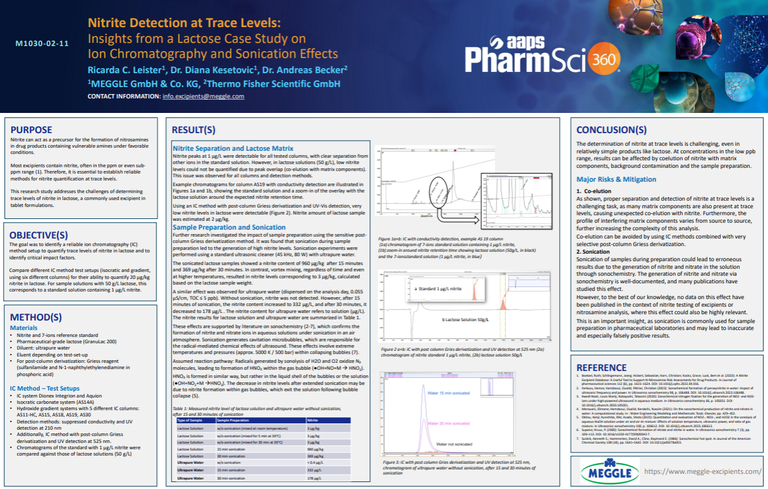
Introduction: Nitrite can act as a precursor for the formation of nitrosamines in drug products containing susceptible amines. Most pharmaceutical excipients contain nitrite at ppm or even sub-ppm levels (1), making reliable trace-level quantification essential.
This study investigates the determination of trace levels of nitrite in lactose, a widely used tablet excipient. The aim was to identify a reliable ion chromatography (IC) setup for nitrite quantification and to evaluate critical influencing factors.
Different IC methods (isocratic and gradient) using six columns were compared for their ability to quantify 20 µg/kg nitrite in lactose. For a 50 g/L lactose solution, this corresponds to 1 µg/L nitrite.
Determining nitrite at such low concentrations is challenging, as results can be affected by matrix co-elution, background contamination, and sample preparation.
Major Risks & Mitigation
Co-elution
Matrix components present at trace levels can co-elute with nitrite, complicating accurate detection. As matrix composition may vary depending on the lactose source, analysis becomes even more complex. Highly selective IC methods with post-column Griess derivatization can help prevent this issue.
Sonication
Sonication during sample preparation may lead to erroneous results due to sonochemical formation of nitrite and nitrate. While this effect is well documented, it has not been reported in the context of excipient nitrite testing or nitrosamine analysis. Since sonication is commonly used in pharmaceutical laboratories, it may cause inaccurate or falsely positive results.
Ricarda C. Leister1, Dr. Diana Kesetovic1, Dr. Andreas Becker2 | 1MEGGLE GmbH & Co. KG, 2Thermo Fisher Scientific GmbH
Poster request: Nitrite Detection at Trace Levels
Fields marked with * are required.