Magnesium stearate as a force control agent in dry powder inhalation – revisiting the mechanism of action.
Introduction:
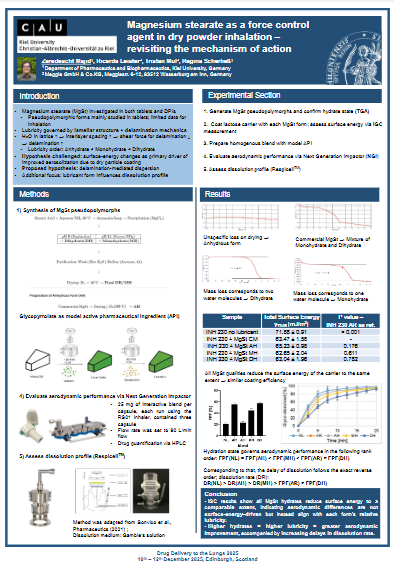
Magnesium stearate (MgSt) is widely used as a lubricant in pharmaceutical formulations and has been extensively investigated in tablet systems, whereas data on its role in dry powder inhalers (DPIs) remain limited. Its lubricating performance is governed by its lamellar crystal structure and the associated delamination mechanics. Variations in pseudopolymorphic forms, particularly with increasing water content in the lattice, lead to an expansion of the interlayer spacing and a reduction in shear forces required for delamination, thereby enhancing the delamination tendency. Consequently, lubricity follows the order anhydrate < monohydrate < dihydrate.
While improvements in aerosolization performance have often been attributed to changes in surface energy due to dry particle coating, this explanation remains under debate. In this work, an alternative hypothesis is proposed, suggesting that delamination-driven mechanisms contribute significantly to particle dispersion. In addition, the influence of the lubricant form on the dissolution profile is considered.
Zeredescht Majid1, Ricarda C. Leister2, Tristan Mul2, Regina Scherließ1
1 Department of Pharmaceutics and Biopharmaceutics, Kiel University, Germany
2 MEGGLE GmbH & Co. KG, Megglestr. 6-12, 83512 Wasserburg am Inn, Germany
Poster request: MgSt in DPI – Mechanism of Action
Fields marked with * are required.